10 Best Swing Trading Strategies For Consistent Profits
Most traders don’t fail because they choose the wrong strategy—they fail because they never stick to one long enough to master it.
They jump from setup to setup, chase price after the move has already happened, and abandon their plan the moment a trade goes against them.
In reality, finding the best swing trading strategies isn’t about discovery—it’s about choosing a structured approach that fits your trading style and executing it consistently with discipline.
That’s the core philosophy behind everything we do at DavronFX. Our platform exists to give swing traders real frameworks they can follow, not hype, not gambling setups, but a rule-based system with defined entries, exits, context, and risk parameters. Every strategy we teach, and every signal we send, is rooted in process-driven trading designed for consistency, not lottery-ticket wins.
In this guide, you’ll learn the 10 best swing trading strategies for consistent profits, and how to apply them the right way in real market conditions. Each strategy includes clear, actionable rules for entry, exit, and risk management, so you know exactly how to put them into practice.
Along the way, you’ll also get a preview of the key steps to select a swing trading strategy that fits your style, ways to test your chosen approach, and how to track your performance to ensure steady improvement. To make this process simple and actionable, here’s a quick outline you can follow:
1. Selection: Choose one strategy from this guide that matches your personality, schedule, and risk tolerance. Focus on a setup that makes sense to you and fits your preferred market conditions.
2. Testing: Backtest the strategy by reviewing historical charts or running through a paper trading account. Track trade outcomes, note which rules work for you under which market conditions, and refine your process until you are comfortable with the approach.
3. Tracking: Record every trade you take using a trading journal tool, including entry and exit, reasoning, and results. Review your performance regularly to find patterns, strengths, and mistakes so you can adjust and improve over time.
This means you won’t just read about new ideas—you’ll know exactly what to do next.
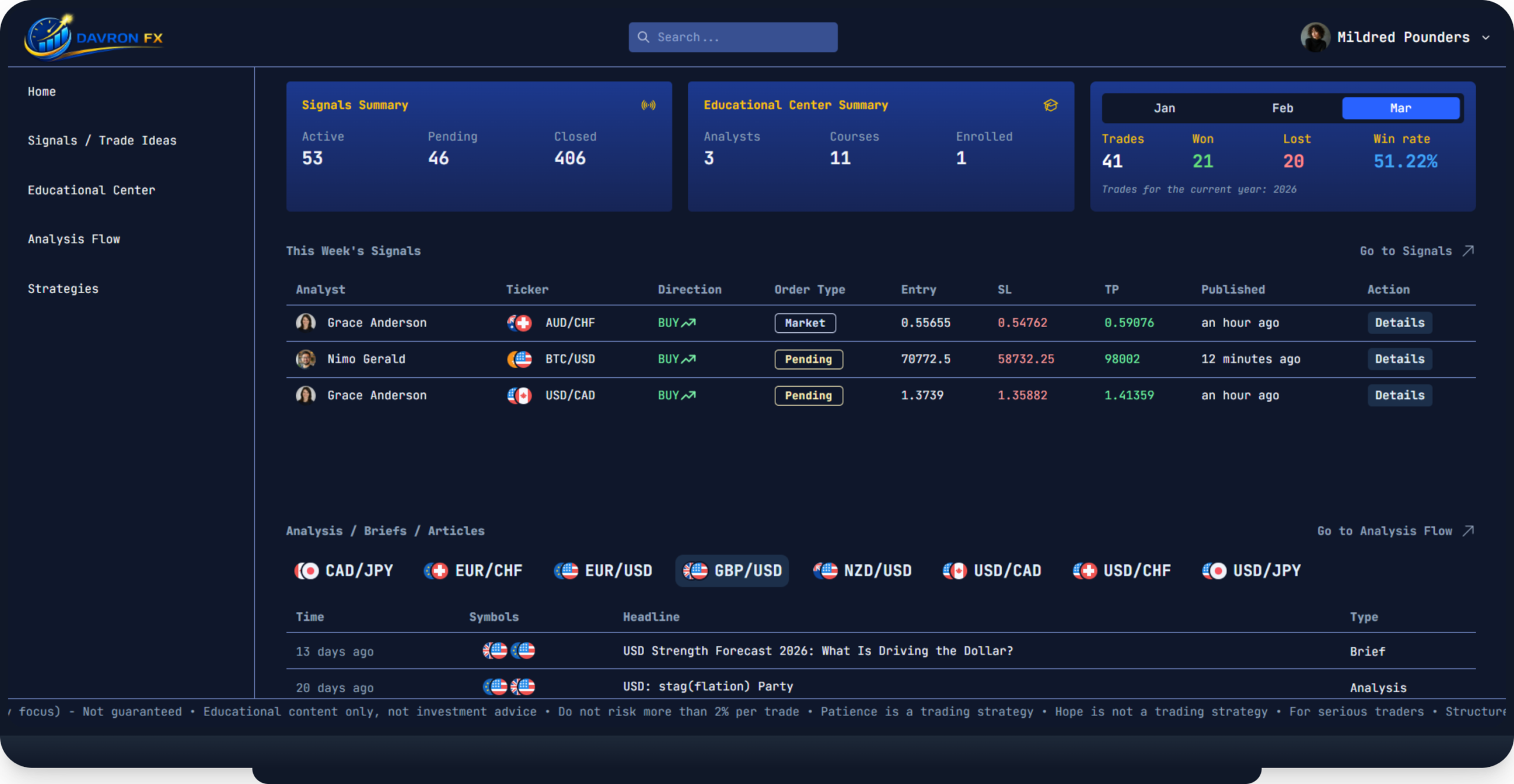
1. DavronFX Rule-Based Swing Trading Framework
The DavronFX framework ranks first among the best swing trading strategies on this list because it does not teach isolated setups. It is a complete trading system built around technical structure, alignment of fundamental bias, and strict risk parameters. By ‘fundamental bias,’ we mean the overall direction indicated by key macroeconomic trends, major news events, or economic data releases that impact the market you are trading.
For example, if the European Central Bank (ECB) announces an unexpected rate hike, that could signal a stronger euro and set a bullish fundamental bias on EUR/USD. In this case, you would only look for long trades that aligned with both the technical structure and the new macroeconomic landscape. Incorporating fundamental bias helps you align your trades with the prevailing forces that are likely to drive sustained movement. You follow the same defined process on every trade, which means results come from consistent execution, not from luck or gut feeling.
Core idea
Rule-based trading means every decision you take is predefined before you enter the trade – nothing is left to impulse or emotion. DavronFX builds the entire framework around one principle: identify the market’s directional bias on a higher timeframe, then wait for price to pull back to a structured level before entering. No guessing, no re-negotiating with yourself, no chasing moves that already happened.
Entry and confirmation
We consider a trade when price reaches a key technical level and is confirmed by clear price action signals—such as a rejection candle, a break in short-term market structure, or a momentum shift aligned with the higher-timeframe bias.
DavronFX only publishes setups that show at least two layers of confluence before execution. This filtering process eliminates weak, low-probability trades that tend to erode performance over time.
Waiting for confirmation is not hesitation. It is the exact discipline that separates consistent traders from emotional ones.
Risk and trade management
Position sizing is already decided before the entry, not after. DavronFX applies strict risk management by limiting exposure to 0.5–2% of account equity per trade and requiring a predefined stop-loss for every setup. As the trade moves in your favor, risk is actively managed by moving the stop loss to breakeven and securing partial profits at the first target level. The remaining position is then allowed to run toward the final exit, ensuring both capital protection and upside participation.
The DavronFX system is designed to bring structure, discipline, and clarity to your trading decisions, removing the guesswork that leads to inconsistent results.
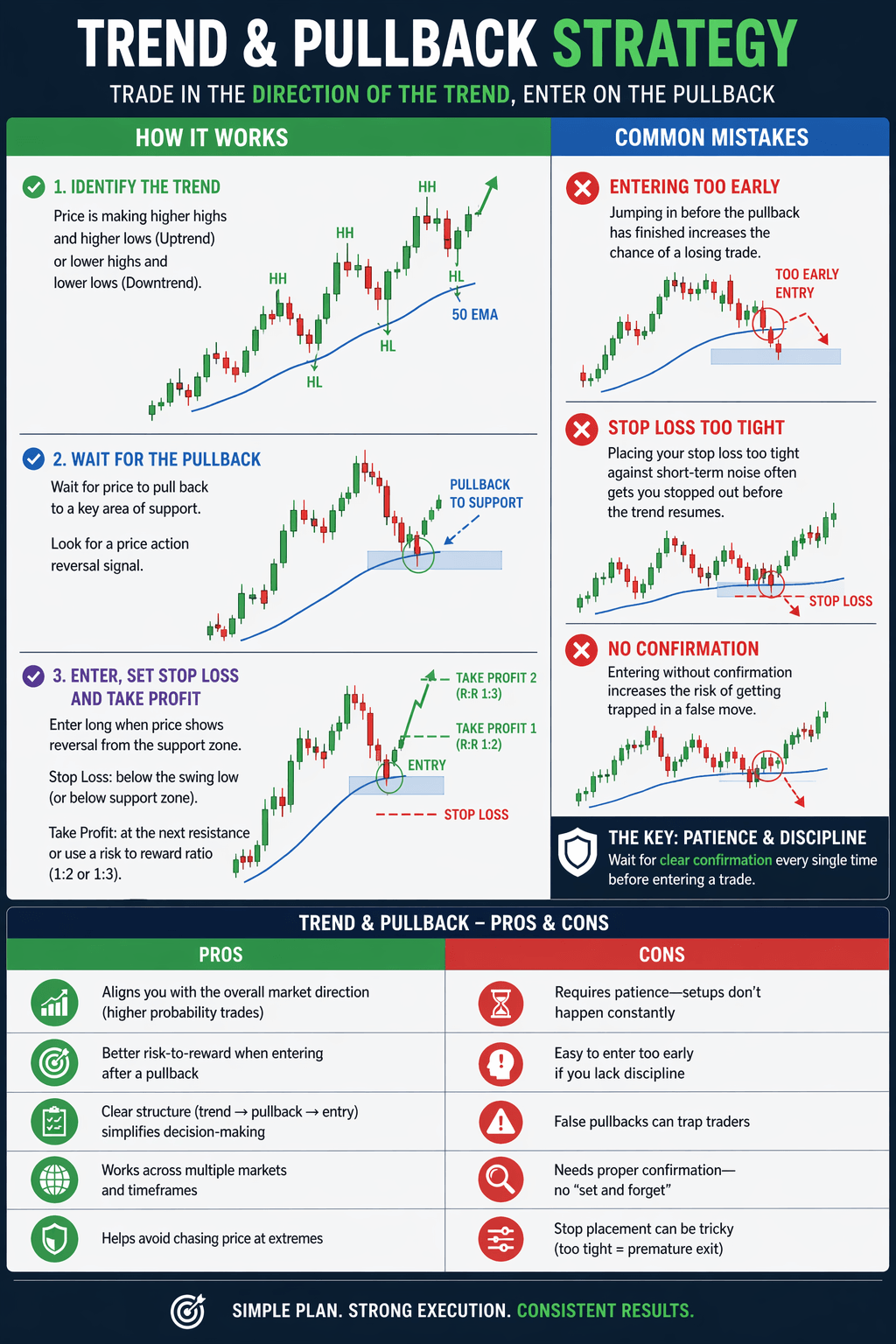
2. Trend and Pullback Strategy
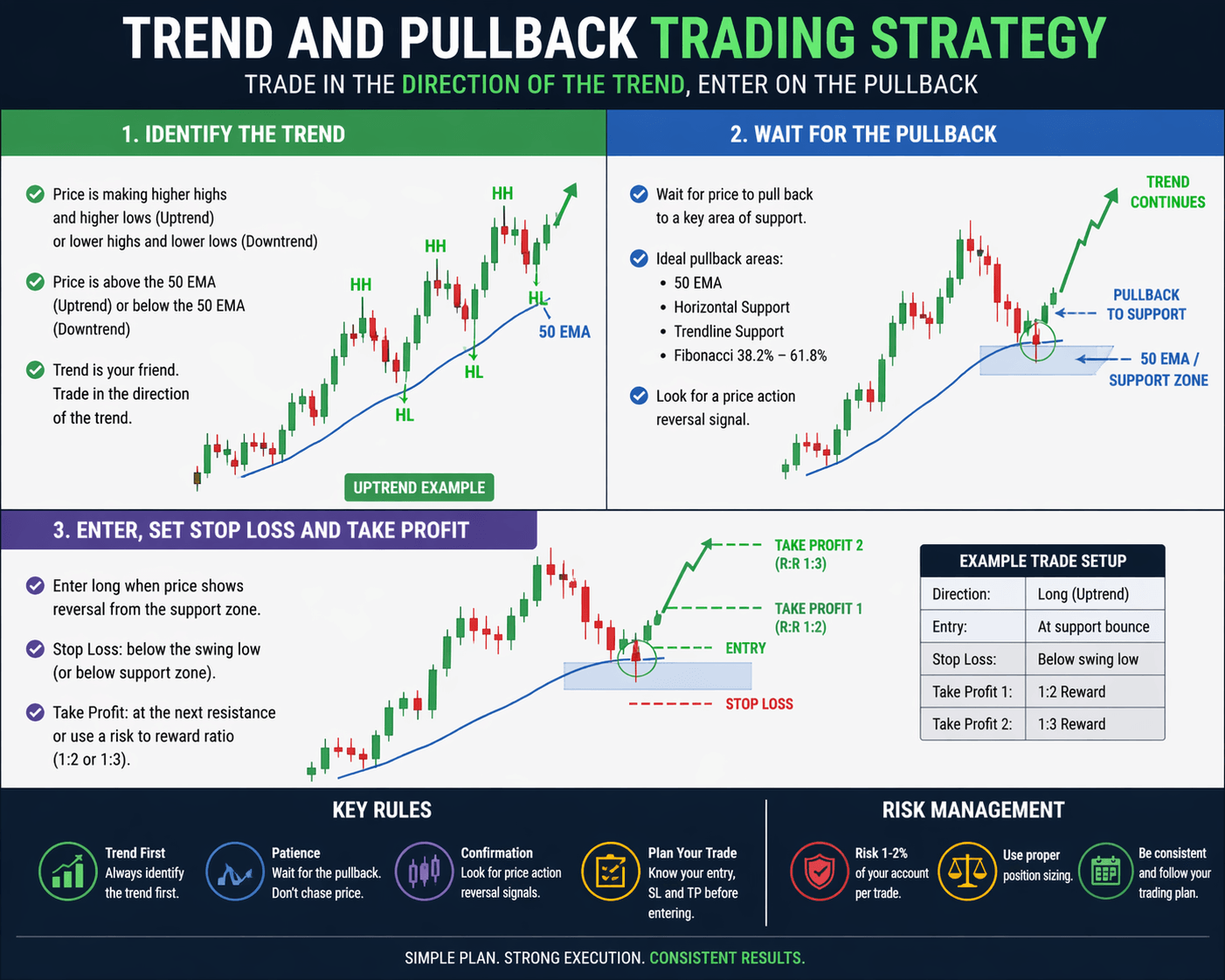
The trend-and-pullback strategy is one of the most reliable approaches in swing trading because it aligns you with momentum rather than fighting it.
Rather than chasing price at extremes, you wait for an established trend to retrace into a key area of value. From there, you look for confirmation that the market is resuming the dominant trend before entering the trade.
This approach focuses on timing, structure, and discipline—helping traders enter with momentum on their side rather than against it.
Core idea
Markets rarely move in straight lines. After a strong directional push, price typically retraces before continuing. Your job is to identify the trend direction on a higher timeframe and then catch price during one of these natural pullback zones rather than chasing the initial move.
Entry and confirmation
You enter a trade when price retraces into a key structural level within an established trend—such as support in an uptrend or resistance in a downtrend.
At that level, you wait for confirmation that momentum is resuming in the direction of the trend. This may come in the form of a bullish or bearish rejection candle, a pin bar, or a break of short-term market structure.
The goal is not to predict reversals, but to enter after the pullback shows signs of continuation in line with the dominant trend, improving probability and reducing premature entries.
The best entries come after patience, not impulse.
Risk and trade management
Place your stop loss below the pullback low in an uptrend, or above the pullback high in a downtrend. Target the previous swing high or low as your first exit, then trail your stop if price extends further. Keep your risk capped at 0.0-2% per trade, regardless of how strong the trend looks.
Best markets and timeframes
This strategy works well in trending forex pairs, stocks, indices, and commodities on the daily and 4-hour charts. Avoid using this strategy when the market is moving sideways or choppy. Trend trading works best when the market is clearly trending. A simple way to spot a trend is to look for a series of higher highs and higher lows in an uptrend, or lower highs and lower lows in a downtrend. If price is not forming these patterns and instead moves mostly sideways, the market is likely range-bound and pullback entries become much less reliable. Remember: use this strategy only when the overall market direction is clear and momentum favors one side.
Common mistakes
One of the most common mistakes is entering the trade too early, before the pullback has fully developed and price is ready to continue in the trend’s direction.
Another major issue is placing stop losses too close to short-term price fluctuations. This often leads to being stopped out by normal market noise, even when the overall trend remains intact.
The key is patience—wait for proper confirmation before entering, and give the trade enough room to breathe so the setup can play out as intended.
3. Breakout from Consolidation Strategy
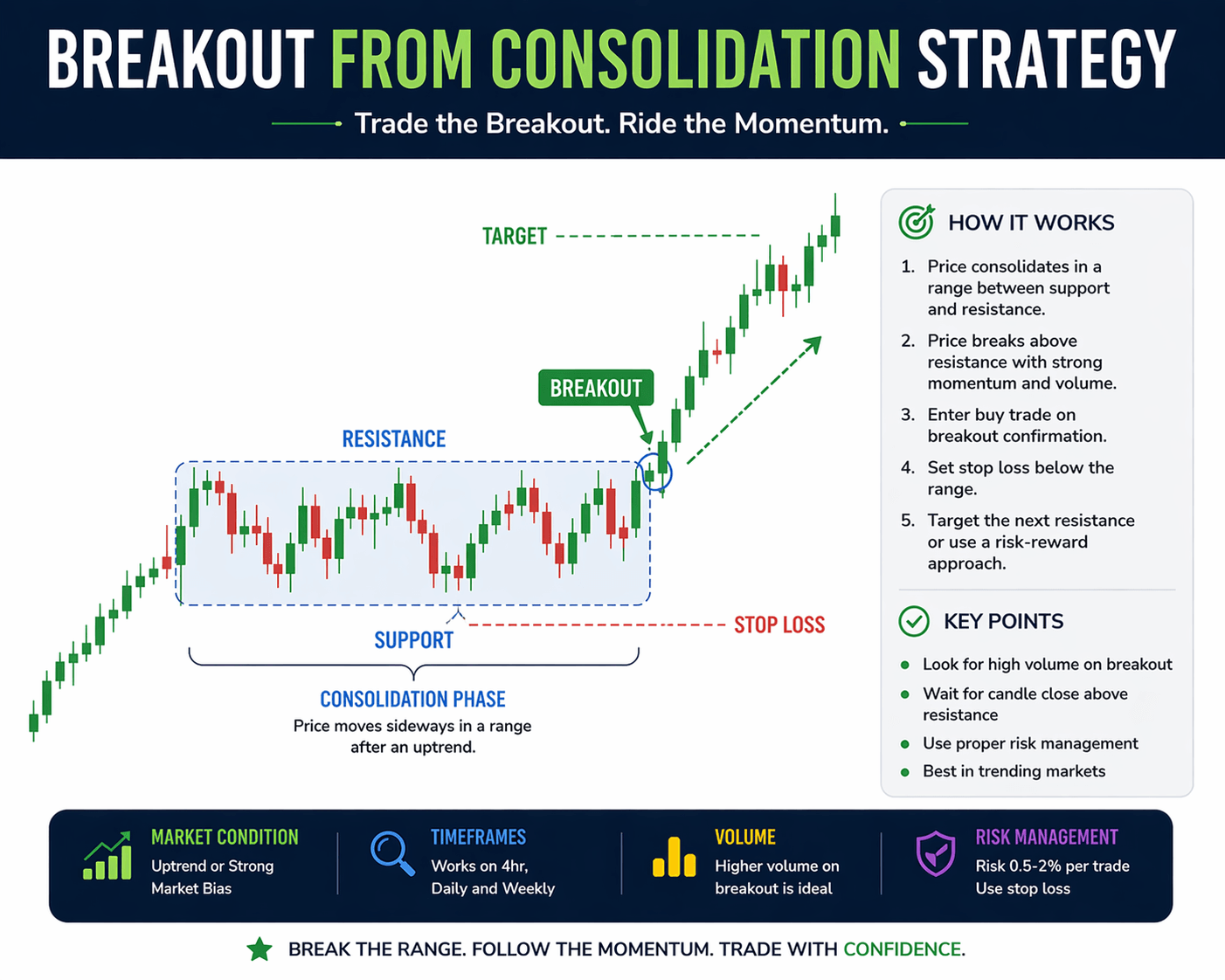
Markets spend a significant amount of time moving sideways before they pick a direction. The breakout from a consolidation strategy lets you position yourself ahead of the next directional move by identifying when the price is coiling inside a tight range and preparing to break out.
Core idea
When price compresses into a narrow consolidation zone, it signals that buyers and sellers are reaching a temporary balance. That balance breaks eventually, and when it does, price often moves sharply in one direction as one side overwhelms the other. Your goal is to identify these compression zones early and wait for a clean breakout with volume behind it before entering.
Entry and confirmation
You enter after the candle closes decisively outside the consolidation range, not before. A close inside the range or a weak wick break is not a valid signal. Look for rising volume on the breakout candle as confirmation that real participation is driving the move, not just a brief liquidity hunt.
A breakout without volume behind it is a warning sign, not an entry signal.
Risk and trade management
Place your stop loss just outside the consolidation zone’s opposite edge. Your first target should be a measured move equal to the height of the consolidation range projected from the breakout point. Move to breakeven once you hit half that target.
Best markets and timeframes
This setup works best across forex, stocks, cryptos, futures, commodities, and indices on the 4-hour and daily charts. It is one of the best swing trading strategies for markets that trend strongly after periods of compression.
Common mistakes
Many traders get trapped by entering on the wick instead of waiting for a confirmed close, placing them right in the middle of a false breakout. It feels like momentum, but it’s often just noise.
The second mistake is just as damaging—pushing the stop loss too far out in an attempt to “stay safe.” In reality, that move kills your risk-to-reward before the trade even has a chance to work, turning a good setup into a poor one from the start.
4. Support and Resistance Bounce Strategy
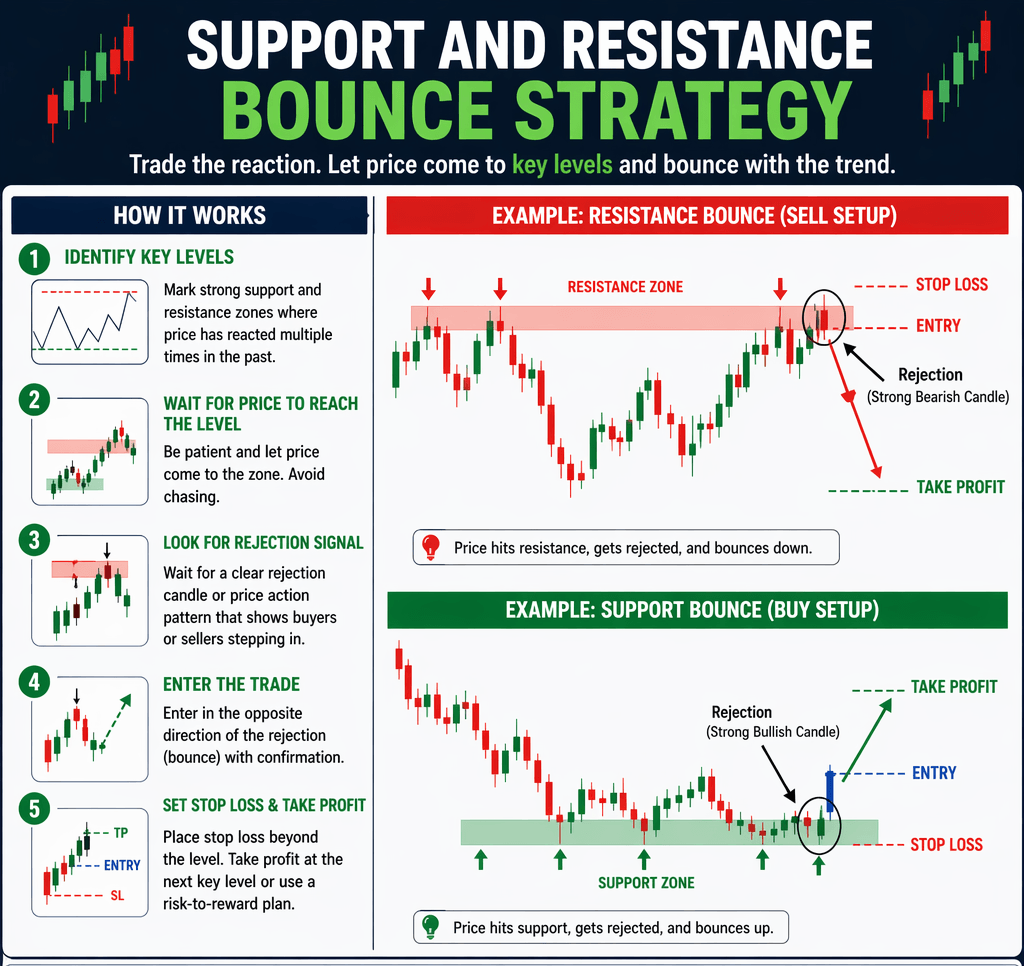
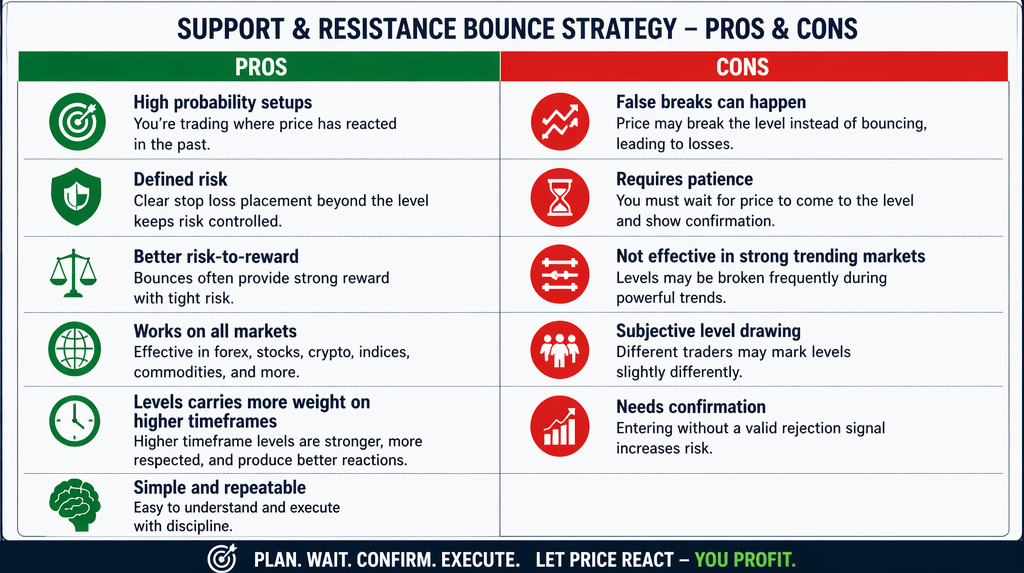
Price respects key levels far more reliably than most traders give it credit for—and that’s where the edge lies. Instead of chasing breakouts, the support and resistance bounce strategy positions you to capitalize on the market’s natural reactions.
Core idea
Price respects key levels far more reliably than most traders give it credit for—and that’s where the edge lies. Instead of chasing breakouts, the support and resistance bounce strategy positions you to capitalize on the market’s natural reactions. When price returns to a well-established level and shows a strong rejection, you step in with conviction, trading the move away from that zone. It’s a more controlled, higher-probability approach: let price come to you, wait for confirmation, and then ride the bounce with intent. Note that this strategy only works with high probability in a ranging market. Once the market starts trending, you’ll be wrong more often.
Entry and confirmation
You enter after price shows a clear rejection at the level, such as a pin bar, a bearish or bullish engulfing candle, or a sharp wick that closes back inside the zone. Do not enter on touch alone. Confirmation is what separates this strategy from guessing which side wins at a given level.
A level is only as valuable as the reaction it produces when price arrives.
Risk and trade management
Place your stop loss just beyond the level you are trading, giving the trade enough room to breathe without invalidating your setup. Target the next significant support or resistance level as your exit point and scale out partial profit when price reaches the midpoint of the range.
Best markets and timeframes
This could be one of your best swing trading strategies, especially when used on the daily and 4-hour charts, where institutional activity consistently reinforces these levels.
Common mistakes
Traders often draw too many levels, ending up with a cluttered chart where every zone looks tradeable. Focus on the two or three strongest levels on your chart and wait for price to come to them rather than forcing setups on weaker zones.
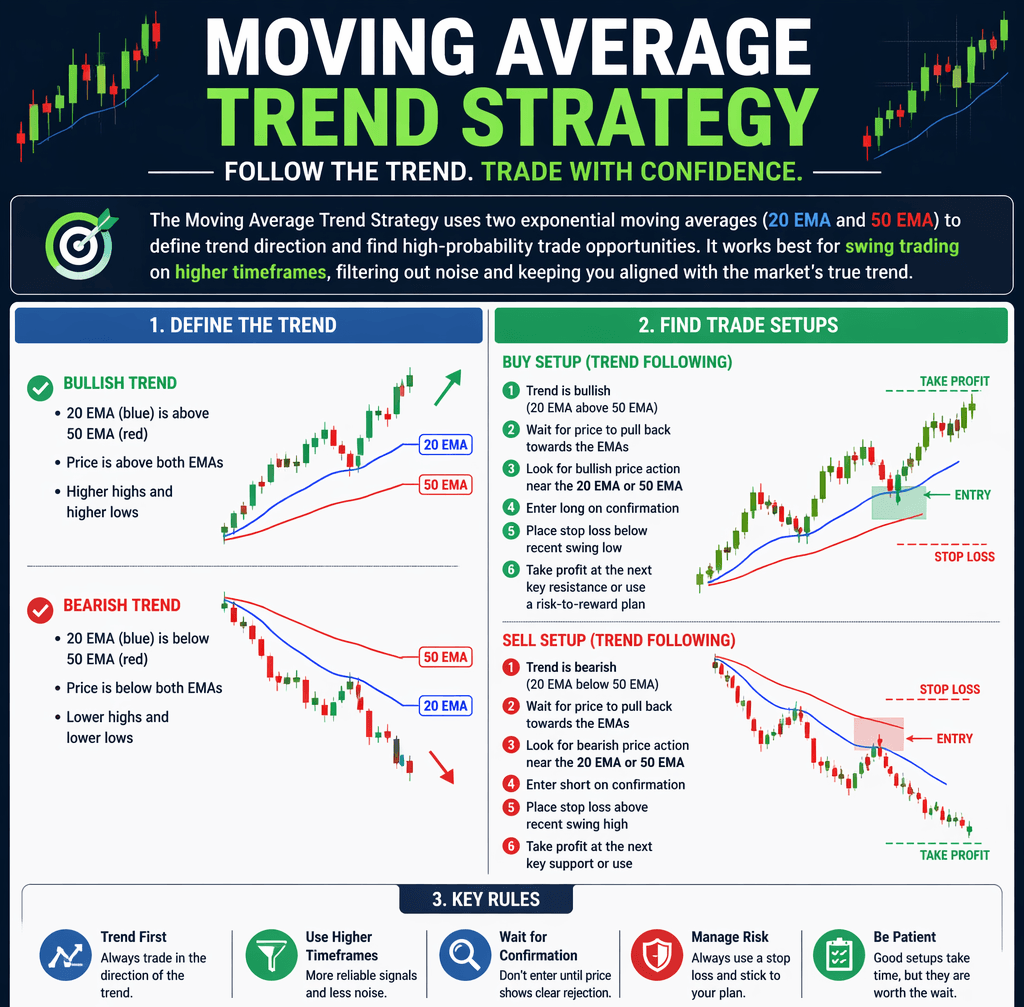
5. Moving Average Trend Strategy
Most traders overcomplicate technical analysis, constantly searching for the next “perfect” setup. But what if the edge you’re looking for is already built into price itself? The Moving Average Trend Strategy strips away the noise and shows you the market’s true direction, filtering out distractions and focusing only on high-probability setups where momentum is already on your side.
Core idea
There are countless ways to use moving averages, and most traders adjust the settings to match their own style. In this approach, though, we keep it simple and effective by focusing on two exponential moving averages—the 20 EMA and the 50 EMA — to clearly define the trend direction. This setup is really effective for swing trading on higher timeframes, helping filter out noise and highlight cleaner, more reliable moves. When the faster moving average is above the slower one, it signals an uptrend—so your focus should be on buying opportunities. When it drops below the slower average, it indicates a downtrend, and you shift your attention to selling setups.
Your job is not to predict where price is going next. You are following structural signals that the market itself presents to you through the moving averages.
Entry and confirmation
You enter when the price pulls back to the faster-moving average in a trending market and prints a confirmation candle, such as a pin bar or bullish engulfing candle. Wait for that candle to close before committing to the position.
The moving average marks where value exists within the trend, not where you blindly buy or sell on touch.
Risk and trade management
Set your stop loss just beyond the slower-moving average—below it for a long trade and above it for a short trade. For your target, aim for the next obvious swing high or swing low. As price moves in your favor and reaches at least 1R, trail your stop loss to breakeven.
Best markets and timeframes
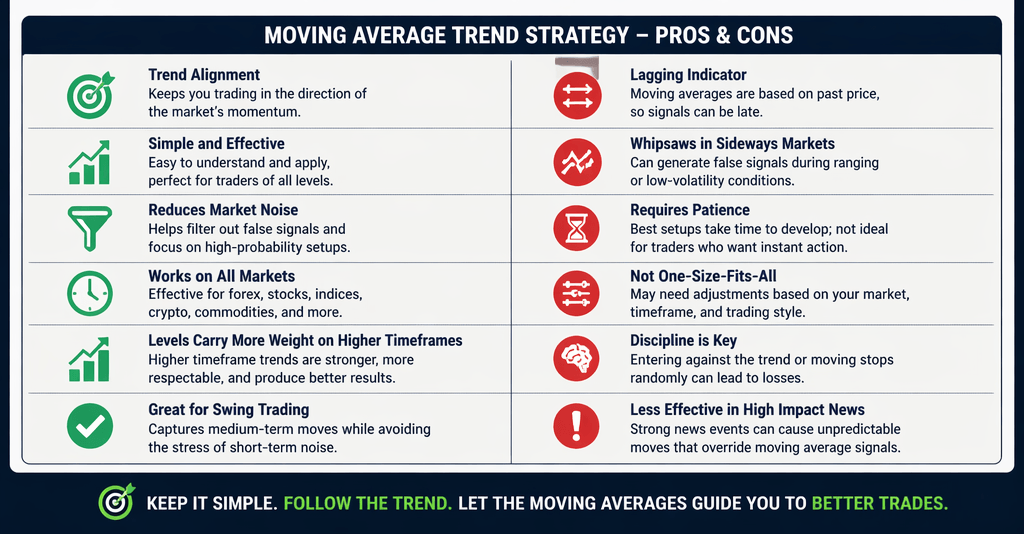
This is one of the best swing trading strategies for trending forex majors and major stock indices on the daily and 4-hour charts. It performs poorly in choppy, low-volatility conditions where price is not moving in a clear direction.
Common mistakes
Traders apply this strategy in ranging markets where the two moving averages constantly cross without producing clean directional signals. If your MAs are flat and tangled together, the strategy is not valid.
6. RSI Mean Reversion Strategy
Core idea
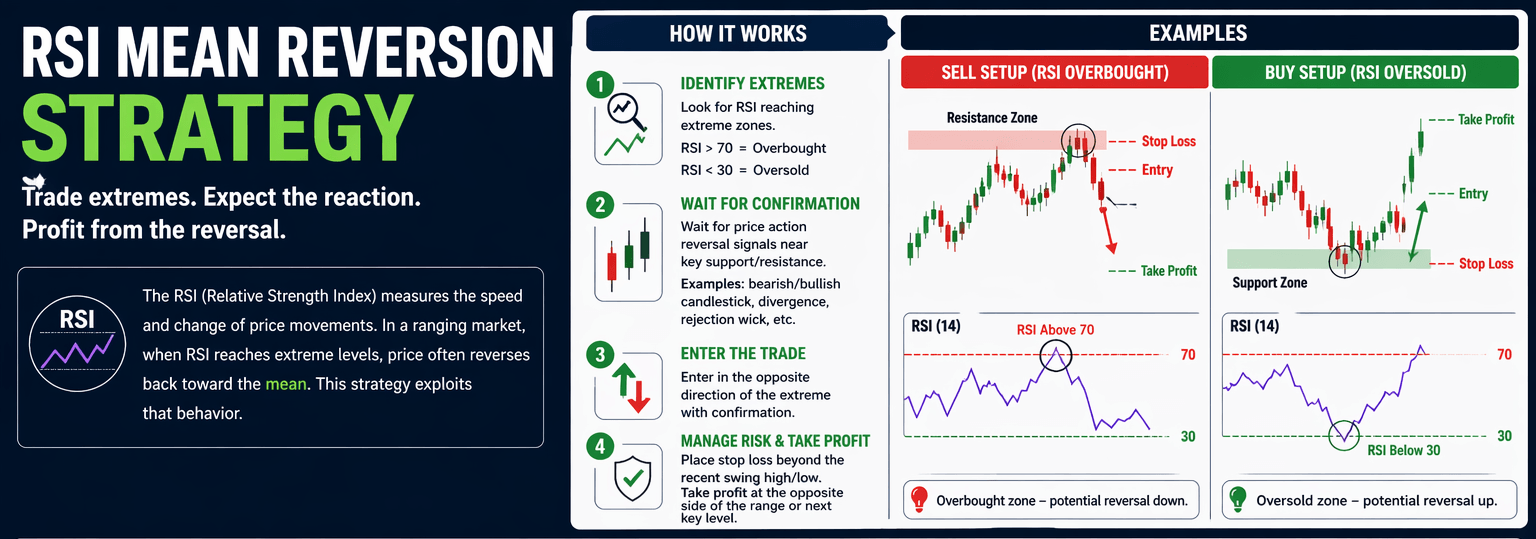
Markets tend to overshoot their levels before returning to equilibrium. The Relative Strength Index (RSI) gauges the speed and size of price changes, helping to identify when a market is overbought or oversold and likely to bounce back before a bigger trend develops.
Entry and confirmation
You watch for RSI to move above 70 for potential short setups or below 30 for potential long setups, then wait for it to cross back through those levels before entering. Entering too early can leave you exposed to extended moves against your position, forcing stops that exceed your planned risk limits. This strategy becomes significantly more effective when it aligns with a higher-timeframe Point of Interest (POI), serving as an added confluence, thereby improving the quality of your entries.
Extreme RSI readings show you where to look, not when to pull the trigger.
Risk and trade management
Place your stop beyond the swing extreme that formed while RSI was in the overbought or oversold zone. Target the midpoint of the prior swing as your first exit, then move to breakeven. Always keep risk capped at 0.5-2% per trade.
Best markets and timeframes
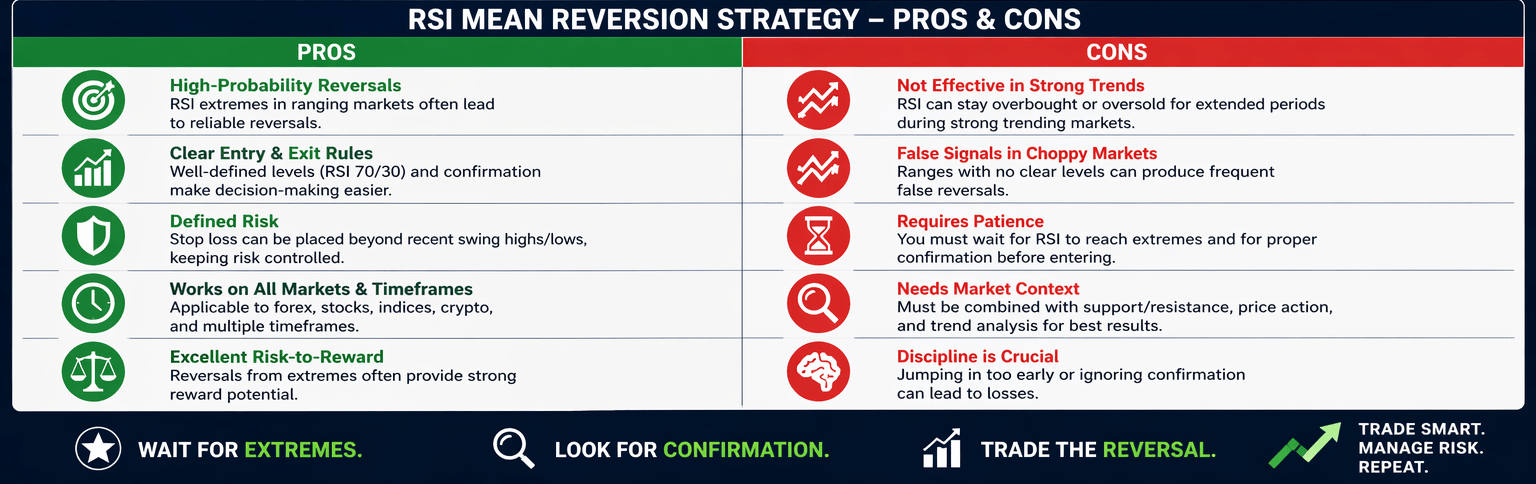
This is one of the best swing trading strategies for range-bound markets. Stronger signal on the 4-hour and daily charts, where price oscillates between defined levels. This strategy fails when the market is trending in one direction.
Common mistakes
Some traders tend to enter on the RSI reading alone, without waiting for confirmation, leading to holding positions through continued extensions. Instead, strengthen your edge by waiting for a specific confirmation signal after the RSI triggers. These confirmation signals can include a strong reversal candle (such as a pin bar or engulfing candle), a break and close above a recent structure level after oversold RSI (or below structure following overbought RSI), or a momentum shift clearly visible in price action. Waiting for these clear confirmations helps ensure the momentum is actually turning and reduces the risk of premature entries.
7. Bull Flag and Bear Flag Strategy
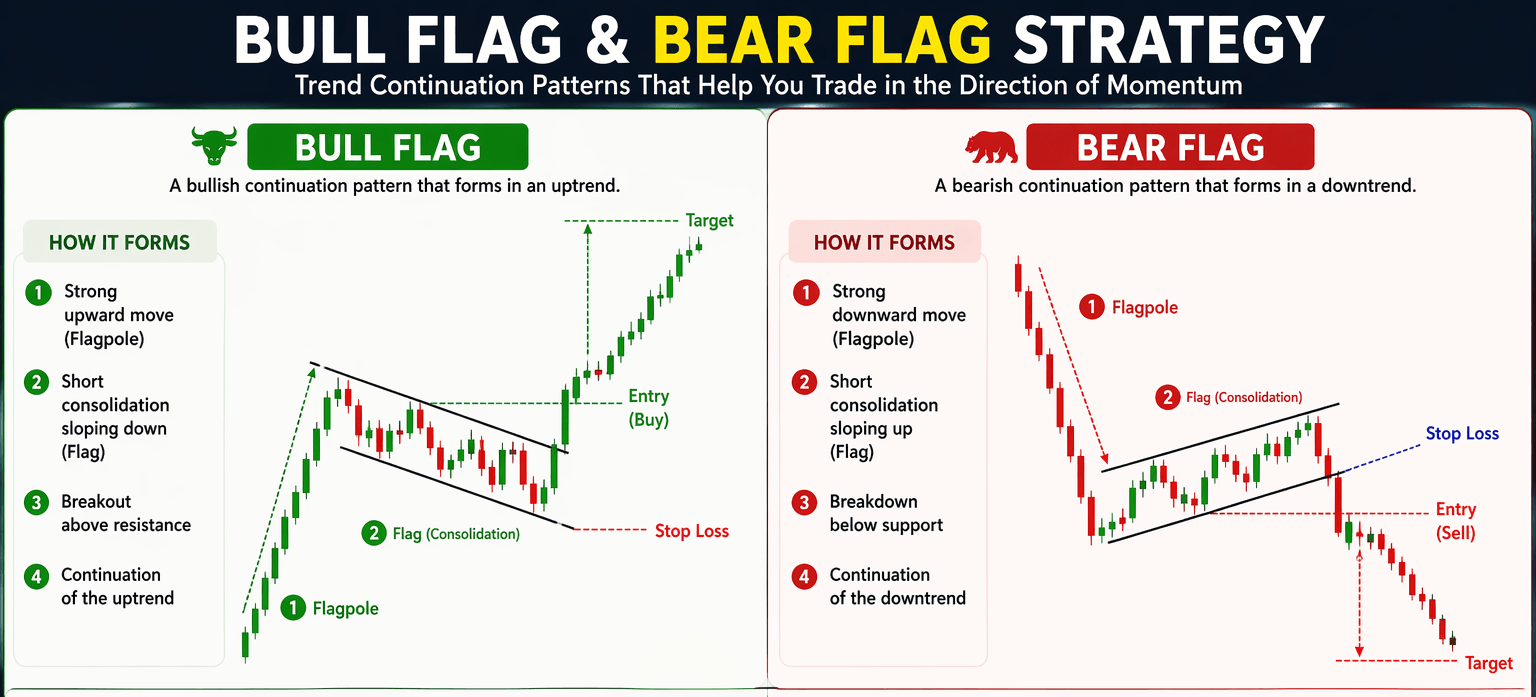
The bull flag and bear flag pattern is one of the most reliable continuation setups you will find in a trending market. After a strong directional push, price consolidates briefly in a tight, angled channel before breaking out in the original direction. These patterns work because they represent controlled pullbacks within strong momentum, giving you a strong entry with clean structure to trade around.
Core idea
Bull flags develop after a strong upward impulse, followed by a controlled, downward-sloping consolidation that forms the “flag.” Bear flags mirror this behavior in reverse. What makes these patterns powerful is the nature of the pullback—it moves against the main trend, signaling a lack of conviction on the part of the opposing side. This typically suggests that the pause is temporary and the original momentum is likely to resume.
Entry and confirmation
You enter when price breaks above the upper boundary of the flag on a bull flag, or below the lower boundary on a bear flag. Always wait for the candle to close outside the channel before entering.
A clean channel breakout with expanding momentum is your green light, not a guess based on pattern shape alone.
Risk and trade management
Place your stop at the lowest point of the flag on bull setups, or the highest point on bear setups. Your target is a measured move equal to the length of the initial flagpole, projected from the exact breakout point. Move your stop to breakeven once price covers half that distance.
Best markets and timeframes
This ranks among the best swing trading strategies for all markets on the 4-hour and daily charts, where strong momentum moves produce clean flagpole structures worth trading.
Common mistakes
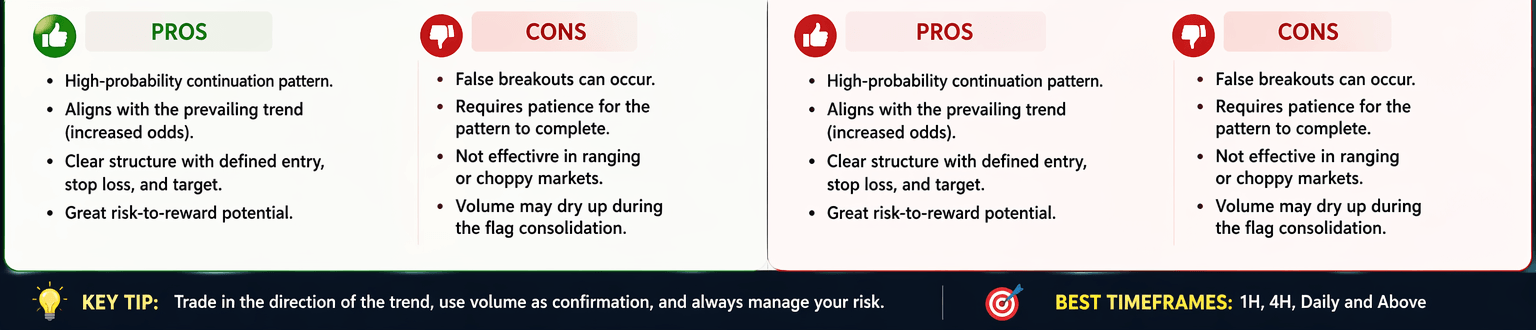
A common mistake is when the pullback is too deep, and you still interpret it as a bull flag — at that point, it’s no longer a continuation setup but a potential reversal. As a rule of thumb, if the flag retraces more than 50% of the initial move (the flagpole), the setup is invalid. Don’t try to make it work—move on to the next opportunity.
8. 20-Minute Opening Range Momentum Strategy
Core idea
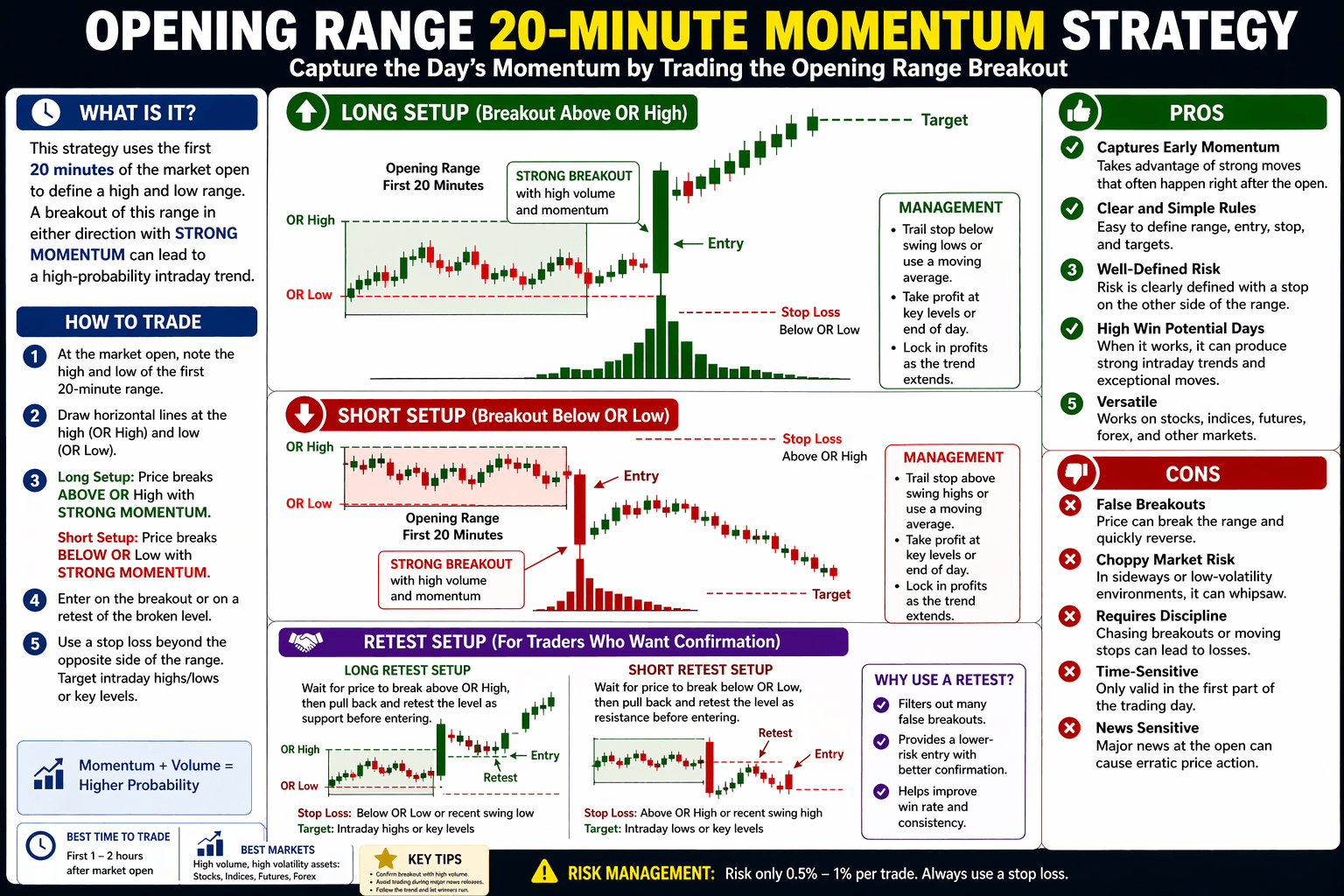
Price action in the first 20 minutes of a session reflects the immediate battle between buyers and sellers, especially after overnight gaps, news events, or pre-market positioning have settled. Once you mark the high and low of this period, you’ve defined the opening range—and that range becomes your key decision zone for structuring the rest of your trade plan.
Entry and confirmation
You enter when price breaks out of the opening range and closes outside it, with clear momentum behind the move. A more conservative approach would be to wait for a retest and a clear rejection. A weak, low-volume break that barely clears the level does not qualify as a valid entry signal.
A clean break with expanding candle size tells you real participants are driving the move, not just noise.
Risk and trade management
Place your stop loss on the opposite side of the opening range to clearly define your risk. For targets, project a measured move using the range’s height from the breakout point. As the trade progresses, once price reaches halfway to your target, shift your stop to breakeven to protect the position.
Best markets and timeframes
This strategy is ideal for indices, stocks, and forex majors on the 5-minute and 15-minute charts during the first two hours of the New York or London session open.
Common mistakes
Traders enter before the 20-minute window closes, which means the range is not fully established. You also hurt your edge by trading this setup outside of the primary session hours, where volume is thin and breakouts frequently fail to follow through.
9. Multi-Timeframe Alignment Strategy
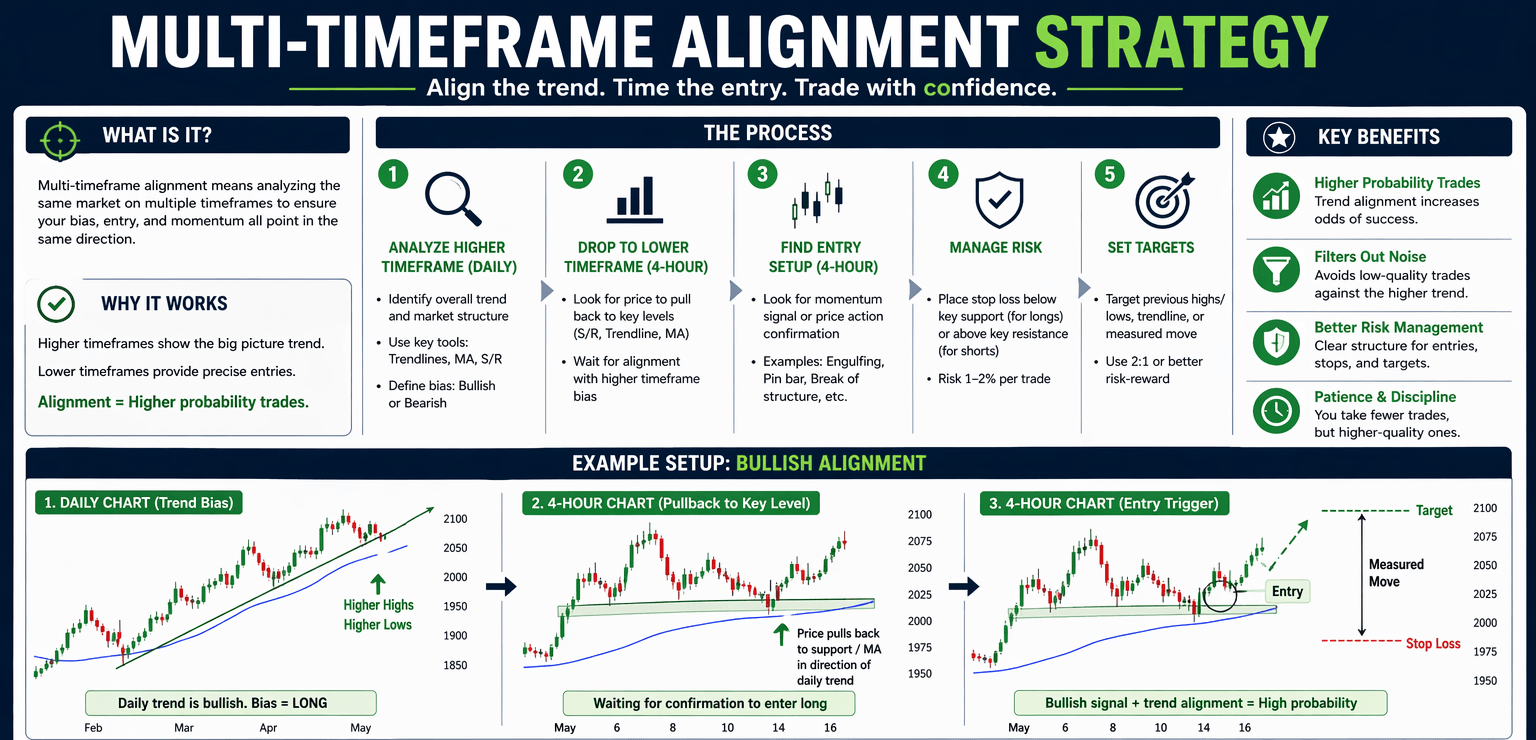
Multi-timeframe alignment forces you to look at the same market from multiple perspectives before committing to a trade. Instead of relying on a single timeframe, you ensure your overall bias, entry zone, and momentum all align in the same direction across at least two timeframes. This filter significantly reduces the number of trades you take, which is exactly the point. But this approach filters out the mediocre setups, leaving you with only high-quality, high-probability opportunities.
Core idea
The core principle is straightforward: higher timeframes set the direction. Remember, the higher timeframe always wins; lower timeframes provide the entry. For swing trading, it’s best to use weekly or daily charts to establish the main trend and find key structural levels, then switch to a 4-hour or 1-hour chart to find a precise entry within that trend. Every trade you place must align with what the higher timeframe is telling you.
Entry and confirmation
You enter when the lower timeframe produces a clear signal, such as a structure break or a structure rejection candle, that points in the same direction as your higher timeframe bias. If the two timeframes disagree, you do not take the trade.
Disagreement between timeframes is not a signal to choose one over the other, it is a signal to wait.
Risk and trade management
Place your stop loss based on the lower-timeframe structure, but size your position using the higher-timeframe context to avoid stops that are too tight relative to normal price movement. Target major swing levels visible on the daily chart as your primary exit point.
Best markets and timeframes
This is one of the most effective swing trading approaches for forex majors and gold, using the weekly or daily timeframe to establish overall bias and the 4-hour chart to fine-tune entries.
Common mistakes
Traders frequently flip their process, using the lower timeframe to set direction, then hunt for higher-timeframe justification after the fact. That approach produces confirmation bias, not actual alignment. Always build your analysis from the top down, never from the bottom up.

10. Event-Driven Volatility Swing Strategy
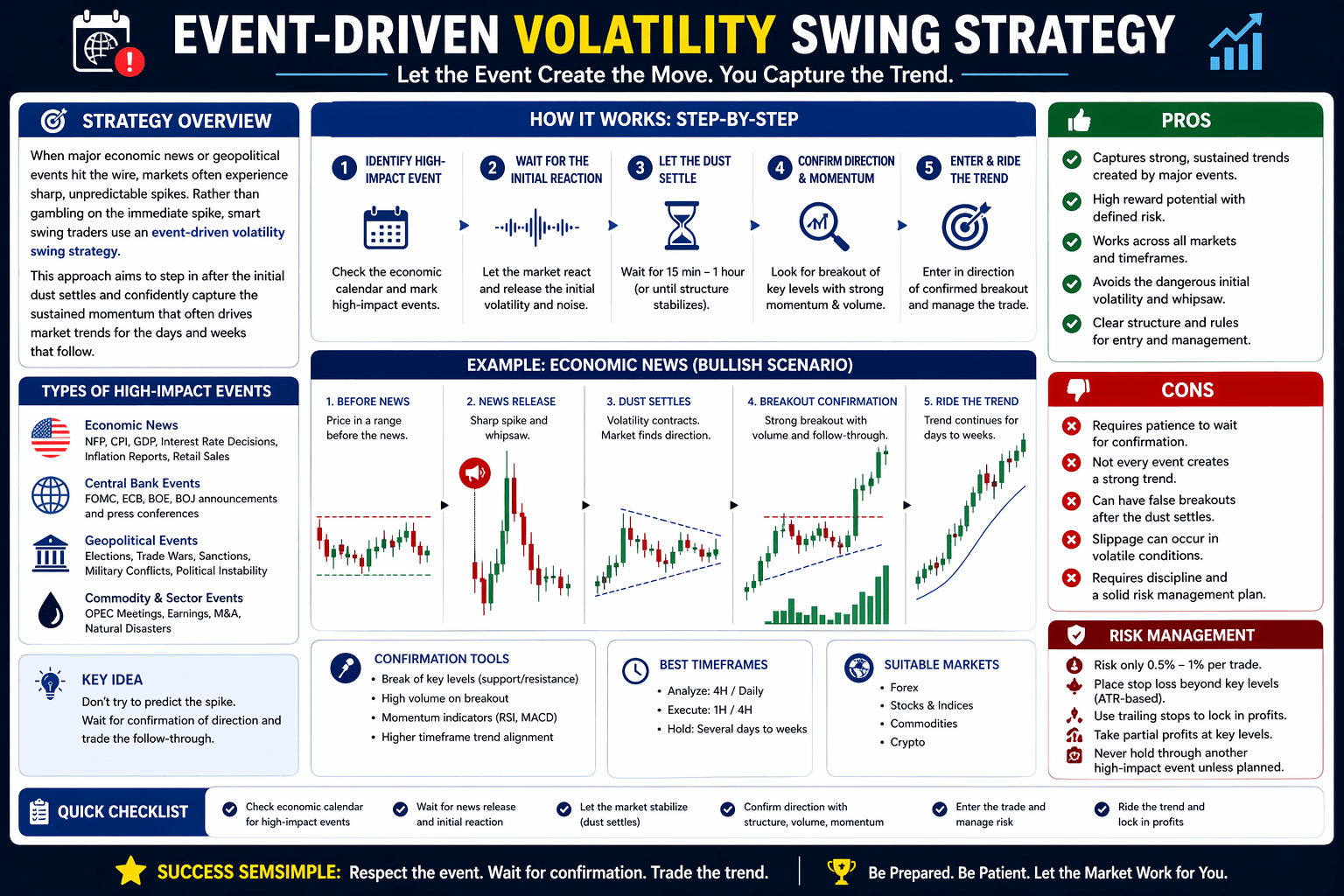
When major economic news or geopolitical events hit the wire, markets often experience sharp, unpredictable spikes. Rather than gambling on the immediate spike, smart swing traders use an event-driven volatility swing strategy. This approach aims to step in after the initial dust settles and confidently capture the sustained momentum that often drives market trends for the days and weeks that follow.
Core idea
Ever watched the market go crazy after a major news drop? High-impact events can inject sudden volatility into the markets, but the most reliable setups actually form after the initial chaos subsides.
Instead of gambling on the unpredictable swings of an announcement, let the market establish a clear direction first. Once the price settles into a clear structure, you can confidently follow that bias and execute a calculated, low-risk entry.
Common high-impact economic events that can impact the market for days or weeks:
- Central bank interest rate decisions
- CPI and core inflation data releases
- Non-farm payroll reports
Entry and confirmation
You enter after the initial spike, once the price establishes a clear directional trend. For example, you could wait for a break in the short-term structure in the post-event direction before considering opening a position.
Entering before the market picks its post-event direction puts you in a coin flip, not a trade.
Risk and trade management
Place your stop behind the post-event consolidation zone, not behind the spike itself. Your target is the next major structural level visible on the daily chart. Scale out partial profit at the first key level and trail your stop as price continues to extend.
Common mistakes
Traders enter during the initial spike before the market settles, which exposes them to violent reversals that stop them out before the real move begins. You also damage your edge by trading low-impact events that generate short-term noise rather than the sustained directional movement this strategy requires.
Next Steps
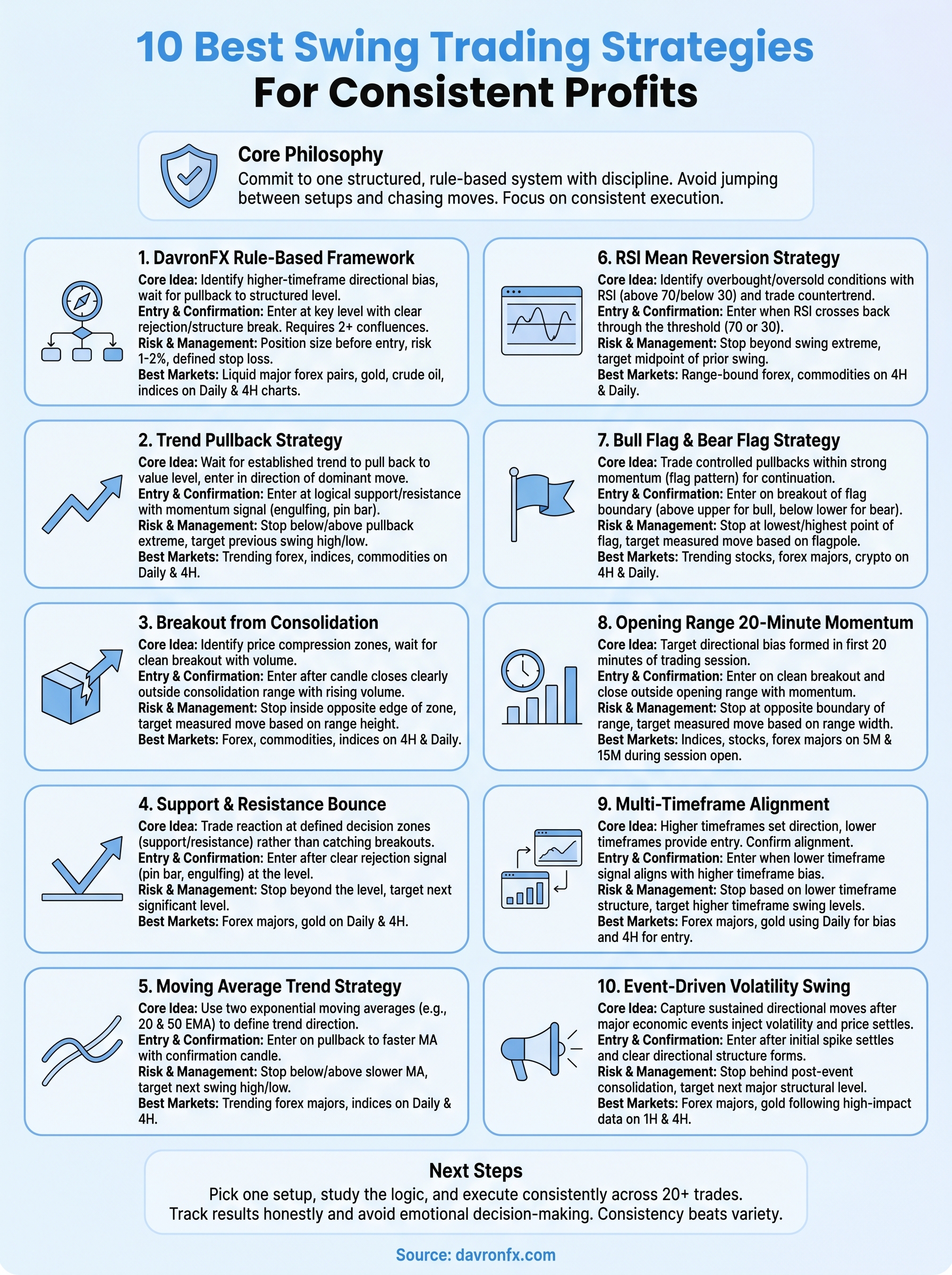
You now have ten structured, rule-based approaches to work with. The swing trading strategies explained above share one common trait: they all require you to define your rules before you enter a trade, not while price is moving against you.
Instead of jumping between all ten strategies, pick just one setup that aligns with your personality. Whether you prefer playing momentum breakouts or buying oversold pullbacks, study your chosen strategy relentlessly. Learn exactly how it behaves, where it excels, and—crucially—where it fails.
Commit to executing your single setup consistently across at least 100 trades. Why 100? Because taking 100 trades lets the mathematical edge of your strategy play out, giving you reliable data on its effectiveness. If your results are disappointing or consistently poor after this sample, use your journal to review each trade, identify where the process broke down, and look for common patterns behind those losses. This way, you can make informed adjustments to your strategy, rather than abandoning it out of frustration.
The best way to track your trades is by using a simple trade journal or spreadsheet. Record every trade you take, including entry and exit points, your reasoning, and the outcome. This approach helps you build discipline, spot recurring patterns, and review your results objectively so you can make informed adjustments to your strategy.
To make journaling straightforward, consider using purpose-built tools. Edgewonk and Tradervue are popular digital trade journals designed specifically for traders, offering powerful analytics and easy trade entry. For a fully customizable and free option, many traders also use Excel or Google Sheets to track their trades. Any of these choices help streamline the process so you can focus on your trading development right away.
Consistency beats variety every time. Jumping between strategies is exactly the behavior that keeps most traders stuck in the same cycle of inconsistent results. Commit to a process, track your results honestly, and adjust based on data rather than emotion.
If you want structured swing trading signals, market intelligence, and mentorship—a system built around disciplined trading—start your trial at DavronFX. Our mentorship goes beyond just trading signals: you get 1-on-1 access to our experienced contributors, Q&A during webinar sessions, trade breakdown, and market intelligence. Whether you need guidance on a specific setup or help reviewing your progress, our team is there to help you build lasting trading skills and confidence.
A typical mentorship session at DavronFX is practical and tailored to your needs. For example, you might share your latest trades for review, then receive direct feedback from a senior mentor on what you did well and where you can improve. During scheduled webinars, you can ask real-time questions about challenging setups, get live walkthroughs of market conditions, or discuss ways to refine your personal trading strategy. This ongoing support is designed to give you actionable steps and steady progress, so you are never left wondering what to do next.